Editor's Note: A warm welcome to the Golden Opportunity free e-letter! You’re joining us at a pivotal time — our readership has been surging as global headlines and geopolitical shifts send undeniable shockwaves through the gold market. You’ve come to the right place for sharp insights, timely updates, and the latest news delivered straight to your inbox. Stay tuned — the golden era is just beginning.
Something huge is happening in the world of global monetary markets.
Even relatively small monetary markets mostly move at a glacial pace.
So when a trend becomes obvious, it usually means it will play out for years if not decades.
That’s been the case when it comes to gold vs. US Treasuries.
For most of modern human history, gold was the world’s global monetary asset. While regular people and businesses settled their affairs in the local currency, sovereign nations usually preferred to settle up in gold.
That arrangement ended in a slow motion collapse starting in 1971 when President Richard Nixon “temporarily” ended dollar-gold convertibility. Nixon created a new monetary framework, where all currencies would float against the dollar, and no more gold would leave US vaults at $35/oz.
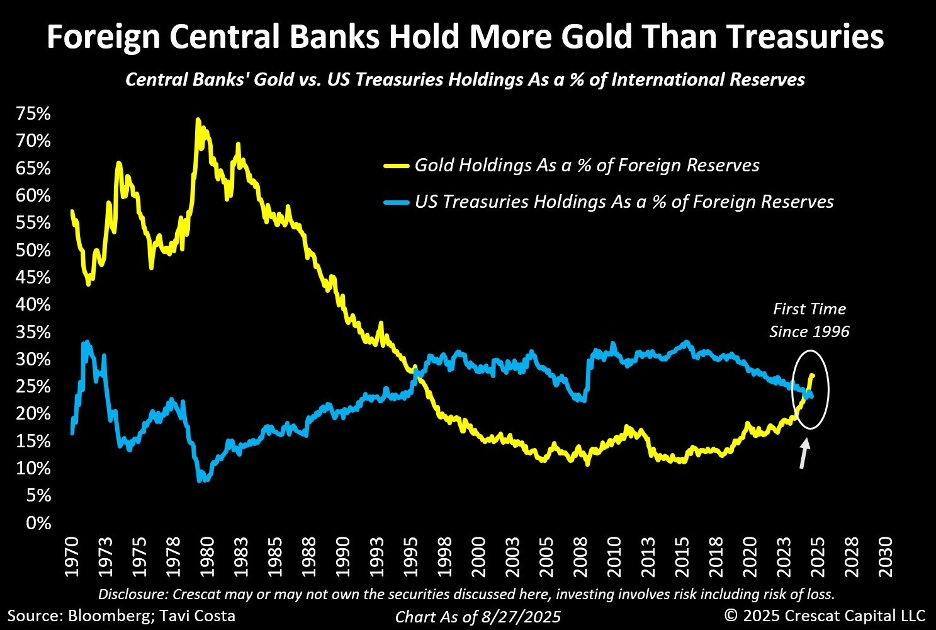
Gold soared in price (to over $800 in the early 1980s)… and simultaneously started to leak out of foreign vaults over the years, and in 1996, foreign banks owned more US Treasury securities than gold.
That scenario lasted for nearly 30 years. Recently, gold overtook US Treasuries as a percentage of foreign central bank holdings.
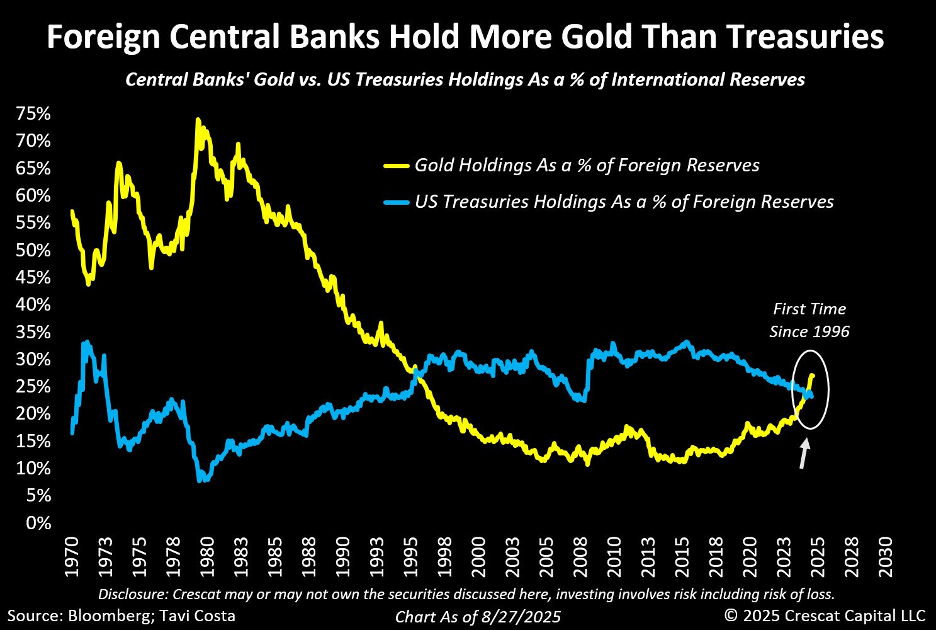
As you can see from the chart, it just blew by, and gold accumulation as a percentage of foreign bank assets is flying straight up. You can see that at current levels, gold makes up maybe 30% of foreign central bank assets.
But if that percentage gets back to the 60-70% levels we saw in the 1970s, it would mean two things:
- Much more gold buying from foreign banks.
- A commensurate decline in US Treasury holdings.
The Treasury market is already pinched between a Federal Reserve that wants to stave off inflation by waiting til the last minute to cut rates, and a White House that wants to juice growth by dropping rates as low as possible.
All of this news is good for gold investors.
It’s not great for people who are on fixed incomes, or who earn low wages, or who want to buy their first home or start a family.
The era of easy money policy that ballooned the US deficits to pay for bread, circuses, wars and political graft is just beginning to manifest. We saw a tiny taste of elevated inflation a few years ago – but it could get much worse.
Of course, that’s part of the thesis of why we’re investing in gold. Neither the US nor any other central bank is in charge of gold. They can’t print it. They can’t decide its price. They can’t unilaterally decide it’s worthless, or seize it electronically.
Students of monetary history know that gold and gold stocks tend to do well while international monetary systems are in crisis.
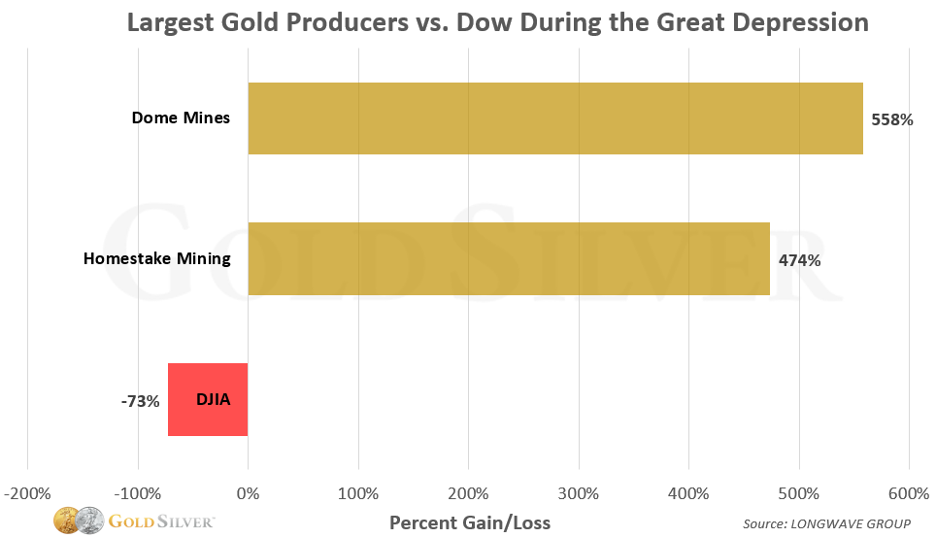
Some of the only big stock market gains during the Great Depression were in the gold sector, with stocks like Homestake and Dome mines producing incredible gains while everything else crashed:
And make no mistake: when you see foreign banks loading up on gold, it’s not because they’re optimistic. It’s because they’re already in crisis. They’re panicking into gold as the only monetary asset they can count on.
This trend is not going to suddenly reverse course. As I said, monetary trends play out over decades…
It could get a lot worse for everyone who is not well invested in gold.
Let’s hope for the best and prepare for the worst.
Best,
Garrett Goggin, CFA, CMT
Lead Analyst and Founder, Golden Portfolio