I’m not a musical theater fan, but there’s no question that Lin-Manuel Miranda’s musical “Hamilton” is one of the biggest cultural sensations in recent history.
The story loosely follows Alexander Hamilton’s personal life and his grapple with his legacy before, during and after the American Revolution.
Hamilton’s real legacy reached much further than his love life and his duel with Aaron Burr. As the nation’s first Treasury Secretary, he kicked off a ~150 year economic policy transforming America from a small, agrarian backwater to the world’s most prosperous industrial powerhouse.
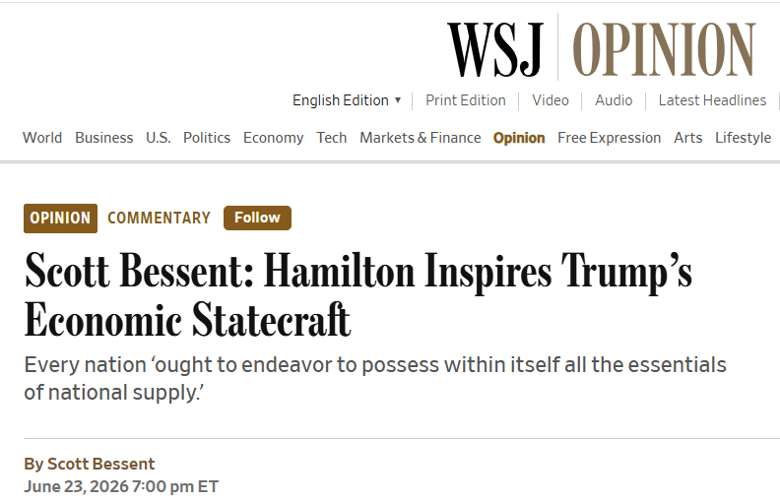
Treasury Secretary Scott Bessent recently penned an op-ed in The Wall Street Journal heavily quoting Hamilton’s framework. While not as catchy or pop-cultural as Miranda’s musical, Bessent hit on something important about what makes a country truly prosperous.
Hamilton’s primary principle: every nation “ought to endeavor to possess within itself all the essentials of national supply.”
In practice, it means Hamilton and Bessent believe that in order to be truly sovereign as a nation, we need to have the industrial and manufacturing ability to be self-sustaining.
That means: domestic production of not just food, but machinery, energy and raw materials. Today, the bulk of American goods are at least partially outsourced and imported from other countries.
Famously, our biotech, defense, and many key raw materials are outsourced to places like China and India.
In a world where China is more of a rival than an ally, that’s a problem. You might remember back during the early days of Covid when many of our medical supplies were running low – because almost all of the masks, respirators, therapeutics and even basic OTC drugs came through China.
God forbid we get into some kind of military conflict with China…
As Bessent writes, “Our strength is derived from what we can build, for the nation that can’t produce what it needs isn’t truly secure. The nation that depends on its adversaries for critical inputs isn’t truly sovereign. And the nation that reduces its economics to consumption isn’t truly prosperous.”
I’ve written many times about Bessent’s other commentary about “monetizing the assets” of the US balance sheet – which I believe is code for “massively revalue gold.”
The only way the US can return to its role as global industrial powerhouse and internally self-sustaining sovereign is to onshore industrial capacity – but key to this plan involves an equally massive devaluation of the US currency.
The thinking is that our high-value currency makes our exports too expensive. Devaluing the dollar also has the benefit of helping to revalue gold much higher, making US debts shrink via inflation.
I’m skeptical of this plan, but it doesn’t matter if it’s a good plan or not for our purposes as gold investors.
From what we’ve seen lately with movements like the end of the petro-dollar, it’s not a sure thing that the US will return to global dominance as an industrial superpower.
The larger point is that we’re not looking at garden variety currency inflation/devaluation.
We’re looking at an administration viewing itself as a historic and heroic movement to change the country for decades to come – and centering a devalued currency and a revalued gold price as the lynchpins of their plan.
As investors, we don’t have to agree with political movements. We don’t have to be on board with economic plans from the big wigs in order to profit from what’s likely to come.
I just mentioned the petro-dollar, which I think is one of the more interesting wrinkles going on in global finance right now. I’ve written what I think is an important insight about the petro-dollar and how unwinding it is impacting the markets. You can read it here.
The most important takeaway from this whole Bessent-Hamilton op-ed is that the story for gold only looks better if what Bessent says is true.
Stay tuned…
Best,
Garrett Goggin, CFA, CMT
Lead Analyst and Founder, Golden Portfolio