One of the biggest reasons for foreign investors and states to hold dollars is becoming irrelevant.
This trend supports gold in a significant way – which is why I’ve put together an investment brief on the subject.
You can read it here for free.
You’ve probably heard of the petro-dollar – but to recap: it’s the global arrangement starting in the early 1970s that settles almost all oil trading in dollars.
If you want to buy a tanker of oil from almost any oil producing country, you need dollars.
That was true even if you weren’t going to consume the oil in the U.S.
So, Japan (a notoriously oil poor country) would have to buy Saudi oil with U.S. dollars. Where did it get these dollars?
Mostly from trade surpluses with the U.S. They send us electronics, cars and Yamaha GC1M Grand Pianos, and we send them dollars.

They also buy some American goods, but the trade imbalance is heavily tilted towards sending U.S. dollars to our trade partners. It’s a great deal for the U.S. There’s no end to how many currency units we can create and send to Japan in exchange for $27,000 pianos.
And it’s actually not a huge problem for Japan either – because Japan needs oil, and oil requires dollars. It’s a neat and tidy system that always creates healthy demand to hold onto the dollar.
For years, people have noted the petro-dollar’s importance in the U.S. dollar’s role as the world’s reserve currency.
Remember: since the end of the Bretton Woods agreement in 1971, there’s no real formal structure that makes the US dollar the reserve currency. Bretton Woods was replaced by the Jamaica Accords in 1976, which says nothing about the role of the dollar – except that the price of gold is no longer fixed in dollar terms.
The real lynchpin of the global dollar market is the petro-dollar system.
Without it: dollar demand falls. What happens then? Well, dollars don’t flow to oil markets. There’s no other global asset that requires dollars.
The only place left is to either buy U.S. Treasuries (boring) or to buy U.S. assets.
When massive waves of domestic currency come home to roost, they bid up asset prices all over the place – including gold.
Which is why any weakening of the petro-dollar is a major warning sign for the dollar.
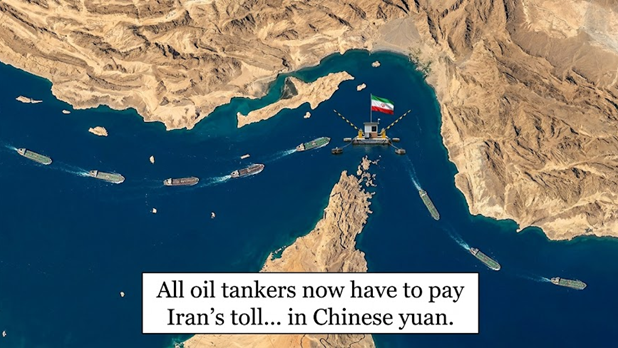
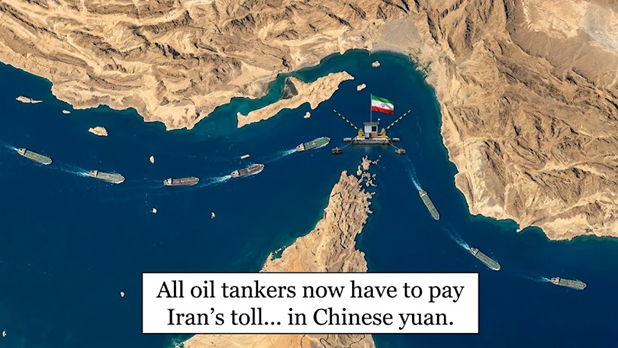
Today, oil traders are paying a toll to Iran in the Strait of Hormuz in Chinese Yuan. Not dollars.
About 20% of all oil flows through Hormuz…
Saudi Arabia already officially ended the petro-dollar agreement back in 2024 – selling it direct to China for yuan.
We’re witnessing the end of a 50+ year arrangement. It’s happening in fits and starts – but make no mistake: the end game is in sight.
The main losers will be regular Americans who see their standard of living further decline. The winners? People who get ahead of this trend and understand that gold is the main beneficiary of dollar destruction.
Get my full write-up on the Petro-Dollar and my favorite gold stocks to own today as a result.
Best,
Garrett Goggin, CFA, CMT
Lead Analyst and Founder, Golden Portfolio