In 1982, you could have bought a 30 year US Treasury bond yielding 15%.
That means you could have received interest payments of 7.5% every 6 months until 2012. Pretty good deal.
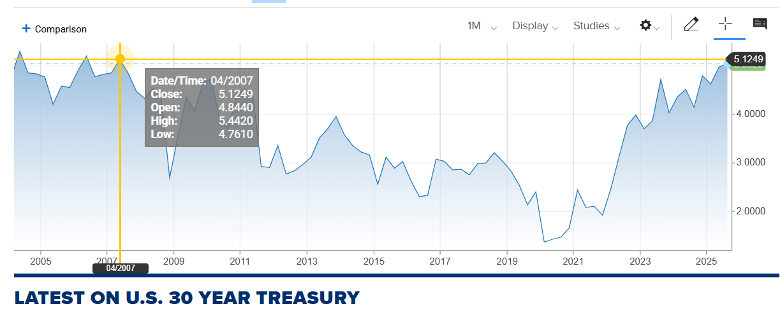
Today, the 30 year Treasury bond hovers around 5% – and if the May 2025 auction was any indication, rates might move even higher UNLESS the Federal Reserve steps in as a bidder.
Over the past 10 years, rates have been well below 5% – bottoming out in 2020 at 1.35%. In fact, yields on the 30 year haven’t been above 5% since April 2007…
If you’ve been paying attention to bond yields at all over the past decade, you might have started to wonder: who are these people or institutions buying bonds at near-record low yields?
Who wants to loan money for 30 years at 5%, let alone lower rates? It seems like a guaranteed way to lose money…
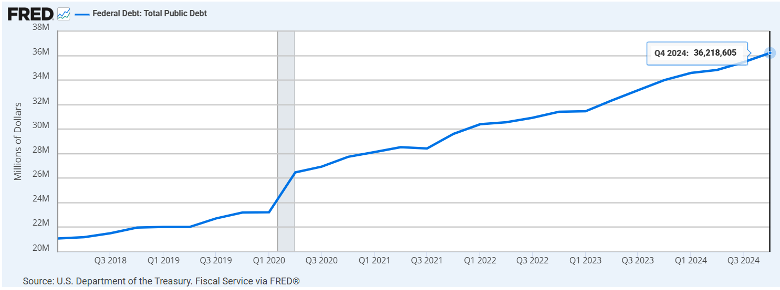
Even back in 2020 when our debts were $13 trillion lower, it seemed foolish to loan money for so long for so little. It was essentially making a bet that inflation would stay near-zero for 30 years…
And back in 2020, the US Treasury sold plenty of bonds – for the precise reason that people and institutions did expect inflation to stay low – or perhaps to drop even lower.
Now of course, after the moderate inflation of 2022 onward, it’s almost unthinkable to lend money for such a low yield.
And even though 5% is the highest yield we’ve seen on Treasury bonds for over 18 years, it doesn’t look like a great deal for investors.
At the same time, 5% is way higher than the Federal Reserve and the US Treasury would like rates to be on the long end of the yield curve.
They really, really want rates to drop down around 3% or lower. That’s not just because they think lower rates will spur growth (as President Trump hopes) – it’s because 5% or higher yields present a serious affordability problem.
Paying 5% on 30 year bonds will dramatically increase the interest expense that already makes up over $1 trillion worth of the Federal budget.
This math is not difficult… every 1% increase in the interest expense on our debt burden of $36 trillion means an additional annual cost of $360 billion to the Federal budget.
And of course, the debt burden grows every year… and our interest expense in the US is already over 3% of GDP.
The answer to “who will buy 30 year bonds at 5%” might be, “no one.”
That’s for the same reason it was foolish to do so in 2020: it is likely to be a money losing venture.
This kind of market in Treasury bonds is partially why gold has done so well. At the margins, gold is an alternative place to park cash for the long term. Even though it does not have a yield, people believe gold will maintain its value.
When the deal for Treasury bonds looks terrible, it does not take many investors buying gold to push the price higher.
The next auction for 30 year Treasury bonds happens in the 2nd week of June. We’ll find out how much appetite there is for 5% bonds – and we might see the Federal Reserve step in to buy bonds just to keep the yield from rising.
In economics, when a central bank buys its own country’s bonds, it’s called “debt monetization.” In other words, a central bank creating money to buy the debt.
And this kind of move typically results in inflation…
Imagine how much more valued gold will be then.
Good investing,
Garrett Goggin, CFA
Chief Analyst & Founder, Golden Portfolio